
What is crazy paving?

Crazy paving is one of the oldest ways to lay stone, and one of the most beautiful when it’s done well. Instead of neat rows of identical tiles, irregular pieces of natural stone are fitted together like a puzzle. The result feels relaxed and organic, as if the path or terrace has always been there.
This guide covers what crazy paving is, which stones we use, where it works best and what to expect when you have it laid.
What is crazy paving?
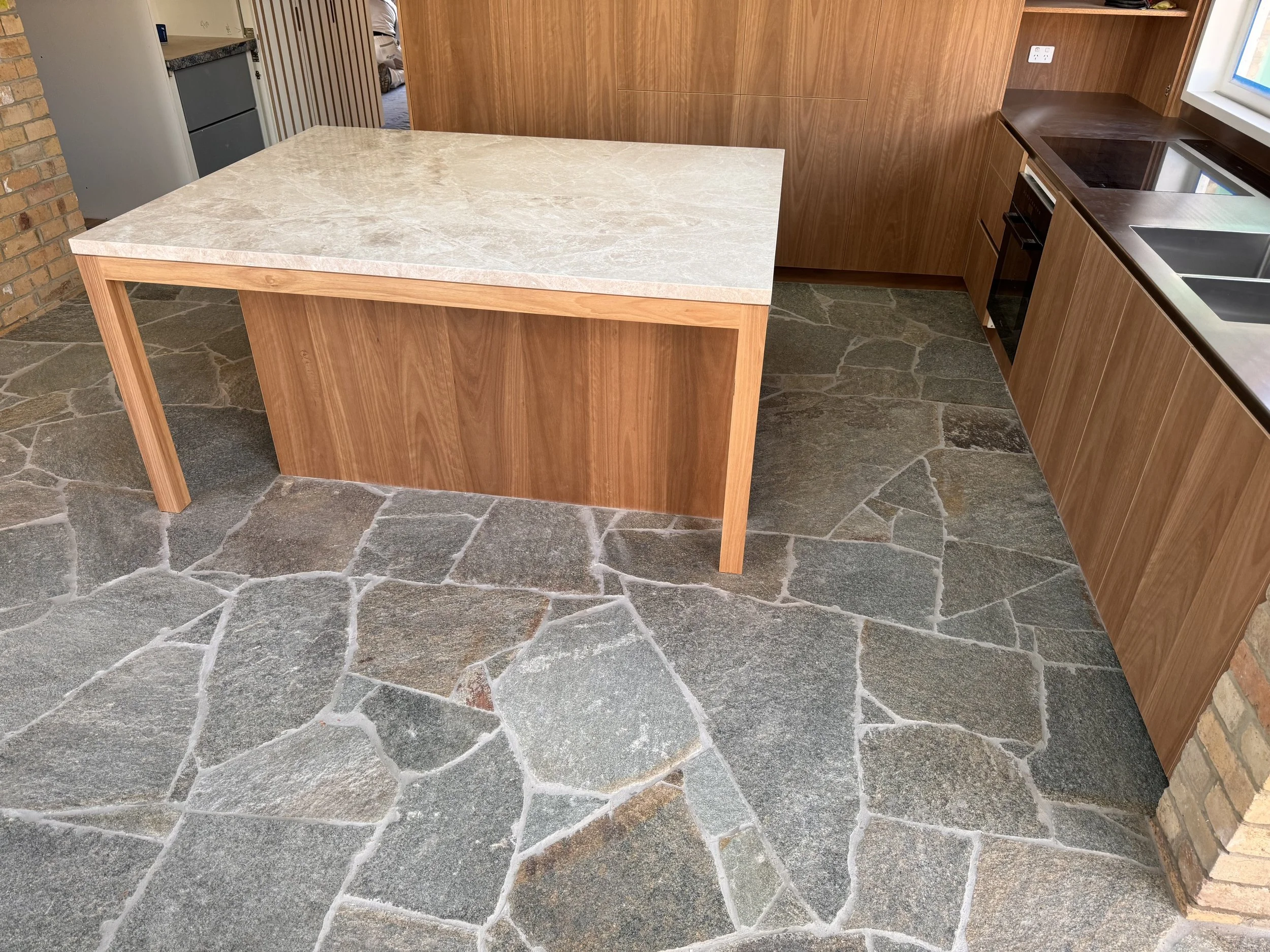
Crazy paving is paving made from irregular, naturally shaped pieces of stone rather than uniform cut tiles. Each piece is selected and placed by hand so its edges sit close to its neighbours, with joints that flow across the surface. You’ll also hear it called flagstone paving, random paving or irregular paving.
It had a moment in Australian backyards in the 1970s, often in heavy, mismatched stone with wide grey joints. Today’s crazy paving is different. Designers are choosing refined natural stones, tighter and more considered joints, and a calmer colour palette. The look is less retro and more timeless: closer to a European courtyard or a coastal garden path.
Because no two stones are the same, no two crazy paving jobs are the same either. That’s the appeal. It’s paving made for one specific place.
Why it suits homes in the Northern Rivers
Crazy paving blurs the line between house and garden. Straight-cut tiles tend to stop hard at the lawn’s edge. Irregular stone can soften into grass, gravel or planting, so the outdoor space feels like part of the landscape rather than something laid on top of it.
That suits the way people live around Byron, Tweed and Kyogle: barefoot, outdoors and close to nature. It also brings some practical benefits:
- Natural texture underfoot. Many natural stones have a textured surface that offers more grip than polished tiles, which matters around pools and outdoor showers. Slip resistance depends on the stone and finish, so we’ll talk you through the options.
- Built to last. Natural stone has been used outdoors for centuries. Laid properly, it weathers gracefully rather than wearing out.
- Works with curves and levels. Irregular pieces can follow curved edges, garden beds and changes in level without awkward cuts.
- Ages well. Stone softens and gains character over time, so the paving looks better in year ten than in year one.
Built for a wet climate
The Northern Rivers gets big rain, and sometimes floods. Natural stone itself isn’t harmed by water. How paving copes with a downpour or a flood comes down to what’s underneath it: the base, the drainage and the joints. We plan for that from the start.
- A solid base. Every stone is bedded in mortar on a concrete slab, so it holds firm against heavy rain and fast-moving water.
- Drainage designed in. Paving is laid with falls that carry water away from your house.
- Sealed against the weather. We seal the stone, so surface water runs off rather than soaking in.
- Repairable. If a section is ever damaged, individual stones can be lifted and relaid, often with the same stone.
- Easy to clean up. Mud and silt wash off sealed stone with a hose.
It’s paving built with Northern Rivers weather in mind.
Which stones can be used?
Almost any natural stone that can be split into flat pieces will work. The stone you choose sets the mood of the whole space. Some of the stones we work with:
| Stone | Look and feel |
|---|---|
| Travertine | Warm, creamy tones with a soft, Mediterranean feel |
| Sandstone | Golden to honey colours that feel at home in Australian gardens |
| Bluestone | Cool grey-blue, crisp and contemporary |
| Porphyry | Rich earthy reds, browns and greys, very hard-wearing |
| Slate | Deep, layered tones with a natural split texture |
| Mudstone | Muted, earthy and understated |
| Cobblestone | Small, chunky stones with an old-world character |
You can also mix stones, such as slate with sandstone, for a more varied, natural look. For more detail on each one, see our Stone guide.
Where crazy paving works best
We lay crazy paving for new homes, renovations and established gardens, from small courtyards to acreage. Popular spots include:
- Pool surrounds. A natural edge that feels like a rock pool rather than a concrete box.
- Courtyards and terraces. An outdoor room that flows straight off the living area.
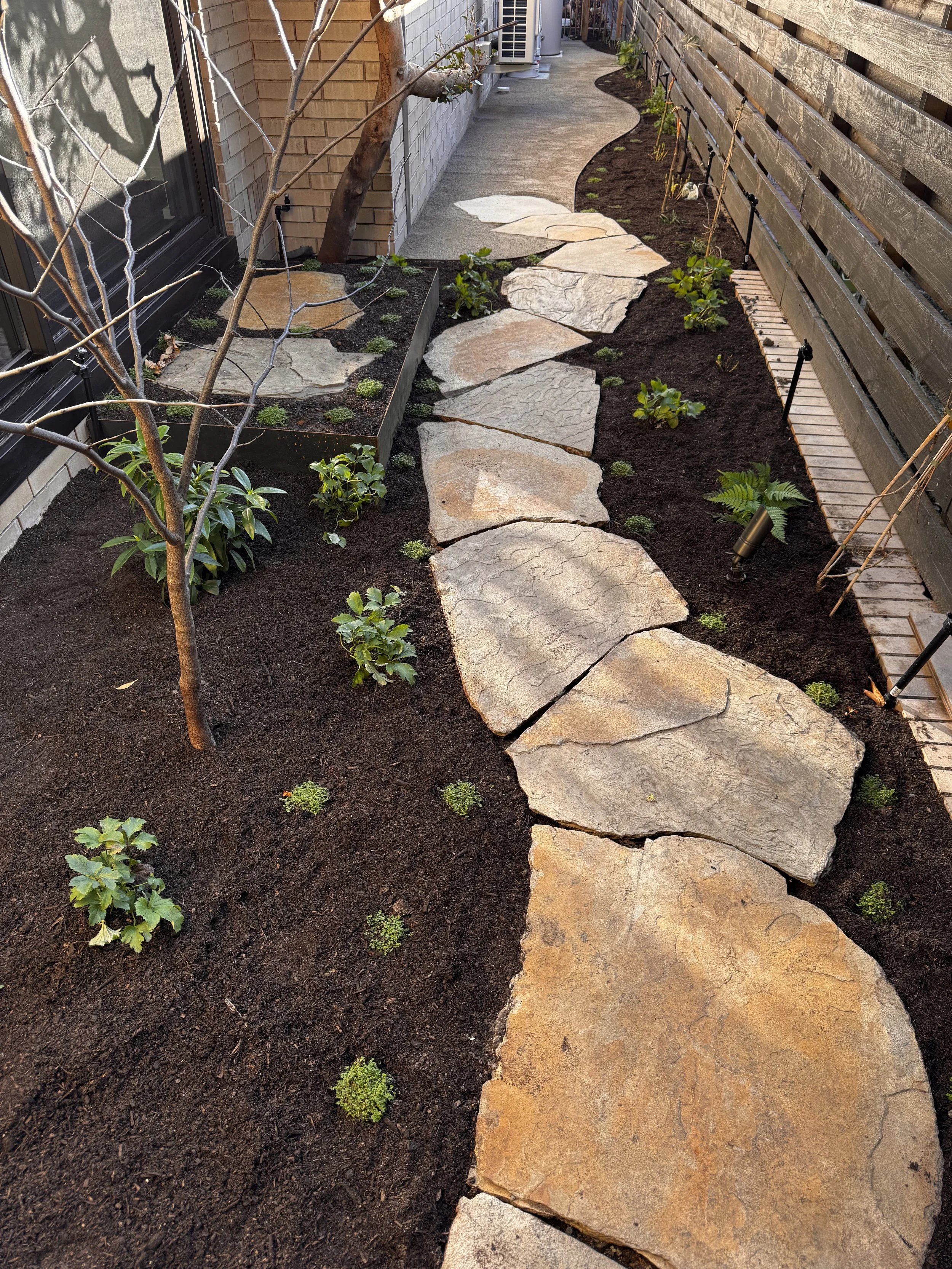
- Garden paths and stepping stones. Paths that wind through planting rather than cutting straight across it.
- Entries and front paths. A first impression with real character.
- Outdoor showers and firepit areas. Small spaces where texture and detail really count.
How it’s laid
Crazy paving is closer to a craft than a production line. Every piece is chosen, shaped and placed by hand, which is why the skill of the person laying it shows in the finished result.
- 01
Site visit and design
We look at the space, how you use it and how it connects to the house and garden, then help you choose a stone.
- 02
Preparing the base
The ground is excavated and a concrete slab is laid, with falls so water drains away. This is the part you never see, and the part that decides how long the paving lasts.
- 03
Laying the stone
Each piece is selected, trimmed where needed and bedded in mortar on the slab. That locks it firmly in place, with joints that flow naturally across the surface.
- 04
Jointing and sealing
The joints are filled, the surface is cleaned and the stone is sealed. Sealing protects against stains and stops surface water soaking into the stone.
Henry has spent five years laying high-end residential paving, including projects with respected landscape designers such as Fiona Brockoff and Florian Wild. He brings the same care to every job, whether it’s a single path or a full pool surround.
Frequently asked questions
Find your inspiration
Browse our Pinterest boards for crazy paving ideas, stone combinations and outdoor spaces we love.
Ready to talk about your project?
Whether it’s a garden path or a full outdoor living area, Henry would love to hear what you have in mind.